




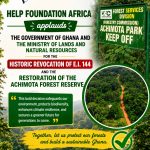

REVOCATION of LI 2462 DOES NOT TOTALLY PROTECT FOREST RESERVES FROM MINING, IF there is NO AMENDMENT of the Minerals and Mining Act, 2006, Act 703.
Act 703 does not ban mining in forest reserves, but in practice, mining in forest reserves is legally possible, relying heavily on executive discretion and inter-agency approvals.
1) Forest Reserves are not automatically excluded land: Section 3 of Act 703 provides that land is available for mineral rights except where the land is: already subject to a mineral right; or “expressly reserved by or under this Act or any other enactment”
Forest Reserves fall under the second category only if they are expressly reserved from mining by:
- Act 703 itself, or
- another enactment (e.g. forestry legislation), or
- an Executive Instrument issued under Act 703.
Thus, forest reserve status alone does not automatically bar mining rather Act 703 establishes a discretionary and conditional regime under which land including forest land may or may not be opened to mining depending on decisions taken under Act 703 and other applicable laws
2) The Minister’s power to reserve land from mining is a critical provision in Section 4 of Act 703. The section gives the Minister responsible for mines the power to formally reserve land from mining by Executive Instrument, with presidential authority
The Minister may reserve land from:
- all mineral rights, or
- specific minerals only.
This means:
- If a forest reserve is not expressly reserved by Executive Instrument, it remains legally open for mineral rights subject to approvals.
- If it is reserved, mining is prohibited unless the reservation is lifted or modified.
3) What the law requires before mining can occur in Forest Reserves
Mining in forest reserves is therefore exceptional, NOT AUTOMATIC. The Act 703 sets mandatory legal thresholds that must be satisfied.
1. Land must NOT be reserved from mining
Before any mining right can be granted:
- The land must not be reserved under:
- section 4 of Act 703; or
- another enactment that expressly excludes mining
If the land is reserved, no mineral right can lawfully be granted.
LEGAL GAPS THAT COULD BE EXPLOITED FOR MINING IN FOREST RESERVE
GAP 1: ABSENCE OF STATUTORY PROHIBITION
No Ghanaian statute expressly states: “Mining shall not be undertaken in forest reserves.”
This allows mining approvals to rely on:
- ministerial discretion,
- political decisions,
- ad hoc EI amendments.
GAP 2: EXECUTIVE INSTRUMENTS OVERRIDE PROTECTION
Forest reserves are protected mainly by Executive Instruments, which:
- can be amended or revoked,
- are not entrenched in legislation,
- are vulnerable to political pressure.
Result: forest reserves can be “opened” administratively for mining.
GAP 3: FORESTRY COMMISSION HAS NO VETO POWER
Under Act 703:
- Forestry Commission approval is required (s.18),
- but refusal does not legally bind the Minister.
Result: Forestry objections can be overridden.
GAP 4: ENVIRONMENTAL PERMITTING IS NOT A PROHIBITION TOOL
EPA processes: assess how mining is done and not whether mining should happen in protected ecosystems.
Result: EIA approval legitimizes mining in ecologically sensitive areas.
CONSEQUENCES OF THESE GAPS
- Legal forest protection depends on political will, not law
- Courts defer to statutory mining rights once granted
- Communities and CSOs face uphill battles in litigation
- Forest loss becomes legally defensible
FINAL LEGAL CONCLUSION
The problem is not absence of environmental concern, but absence of legal finality.
- Act 703 subordinates forest protection to mining discretion
- Forestry laws lack supremacy over extractive law
- Executive Instruments are too weak to protect permanent ecological assets.
Only a statutory prohibition embedded in Act 703 itself, can permanently protect Ghana’s critical forest reserves.
If you are interested in the PROPOSED STATUTORY AMENDMENTS for The Minerals and Mining Act, 2006, Act 703 with clear, enforceable, permanent protection of forest reserves, Please contact
HELP Foundation Africa Policy Desk. Tel: +233244817020. WhatsApp: +233598069009. Email: info@helpfoundationafrica.org
For media inquiries Contact: Kwadwo Kyei Yamoah (+233 244 817020, Kkyeiyams@gmail.com)