


Moving Beyond Clean-Up Exercises: A Sustainable Strategy for Flood Prevention and Waste Management in Accra.
Prepared by: HELP Foundation Africa
Date: July 2026
Executive Summary
The declaration of a two-day national clean-up exercise to desilt drains and remove waste from Accra is a commendable and timely intervention. It demonstrates strong political leadership, mobilizes public participation, and can significantly reduce the immediate risk of flooding during the current rainy season.
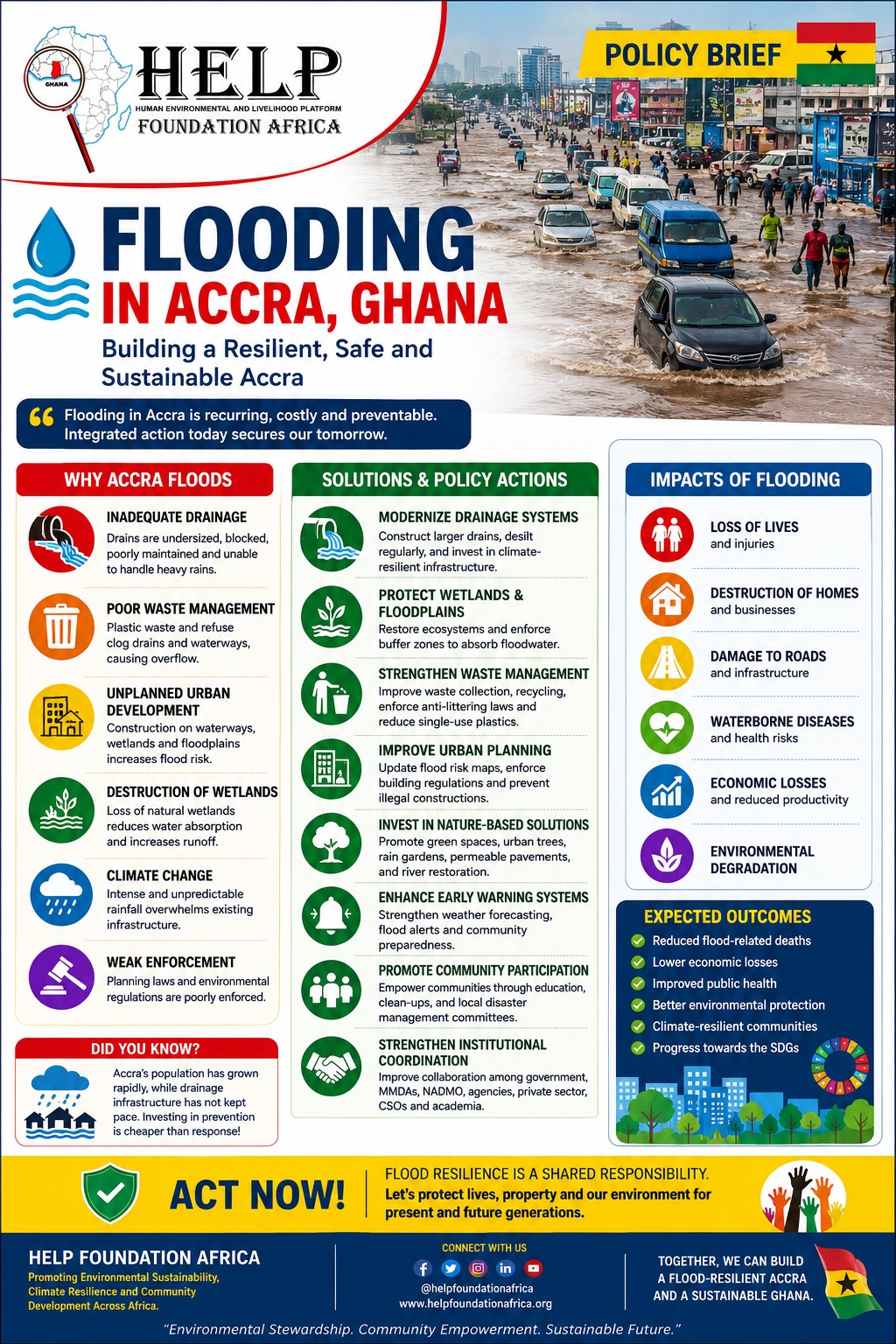
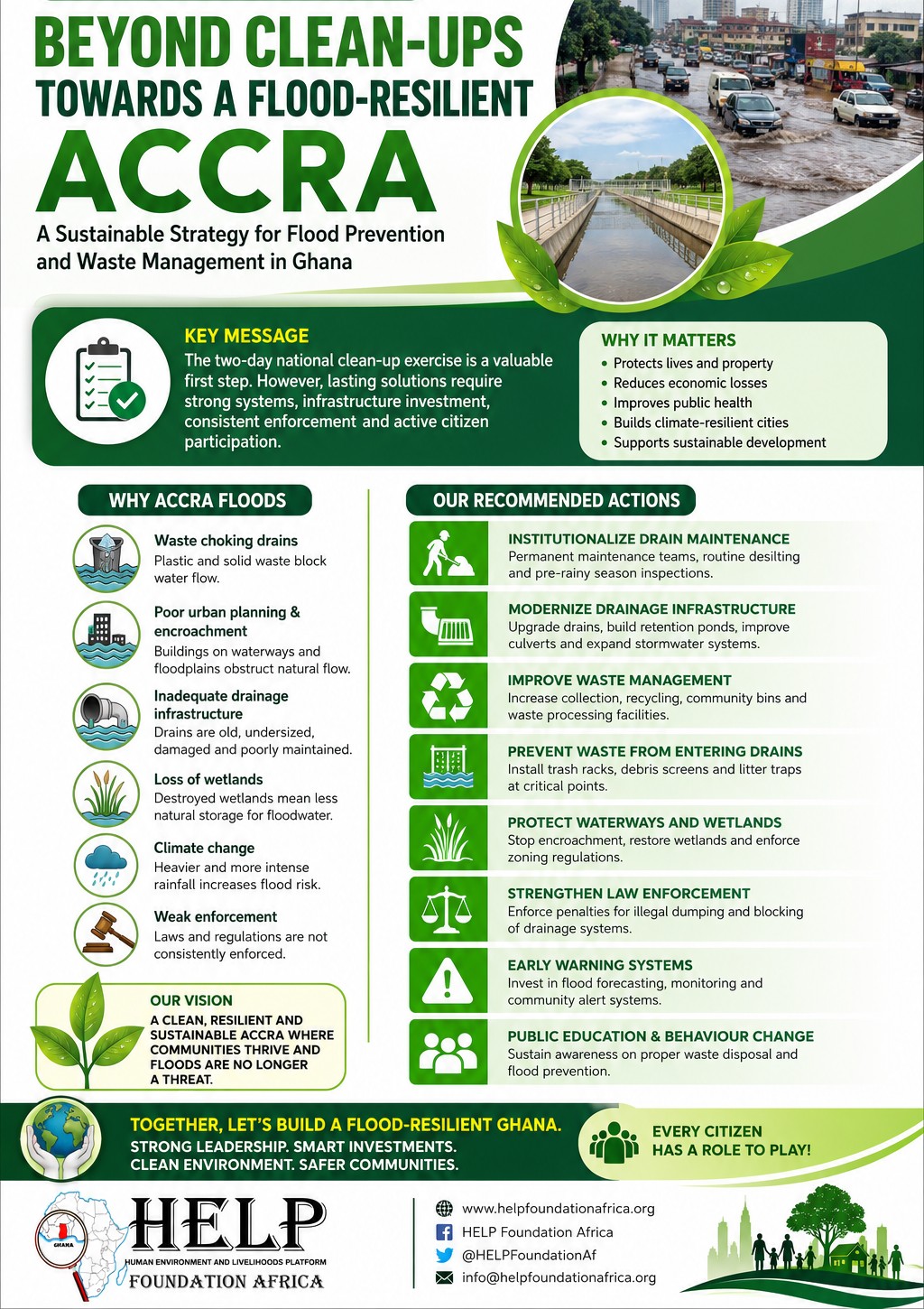
However, the exercise alone will not permanently solve Accra’s recurring flooding problem. The accumulation of waste in drains is only one symptom of a broader challenge involving inadequate urban drainage infrastructure, poor land-use planning, weak enforcement of sanitation laws, destruction of wetlands, rapid urbanization, and insufficient solid waste management systems.
This policy brief recommends a transition from periodic emergency clean-up campaigns to a National Integrated Flood Prevention and Urban Drainage Management Programme, supported by engineering investments, institutional reforms, modern waste management, and continuous public engagement.
Background
Flooding has become one of Ghana’s most costly urban disasters, particularly within the Greater Accra Metropolitan Area.
Each year floods result in:
- Loss of human lives
- Destruction of homes and businesses
- Damage to roads, bridges and public infrastructure
- Increased outbreaks of cholera, malaria and other diseases
- Economic losses amounting to hundreds of millions of Ghana Cedis
- Reduced investor confidence and productivity
Climate change is increasing rainfall intensity, but evidence shows that human activities have significantly amplified flood risks.
Assessment of the Two-Day Clean-Up Exercise
The initiative should be viewed as an emergency risk reduction measure, not a permanent flood mitigation strategy.
Immediate Benefits
The clean-up exercise will:
- Improve stormwater flow by removing waste and sediments.
- Reduce localized flooding during heavy rainfall.
- Raise public awareness on sanitation.
- Encourage citizen participation.
- Demonstrate Government’s commitment to addressing flooding.
These are important short-term outcomes.
Why Flooding Will Continue Without Structural Reforms
Cleaning drains addresses only one contributing factor. The major structural causes include:
1. Inadequate Drainage Infrastructure: Many drainage systems were designed decades ago and no longer have sufficient capacity to accommodate current urban development and increasing rainfall intensity.
2. Encroachment on Waterways: Illegal developments continue to obstruct natural drainage channels and floodplains.
3. Poor Solid Waste Management: Irregular waste collection encourages illegal dumping into drains.
4. Destruction of Wetlands: Natural flood storage areas have been converted into residential and commercial developments.
5. Weak Enforcement: Existing sanitation and planning laws are not consistently enforced.
6. Climate Change: Higher rainfall intensity increasingly overwhelms existing drainage infrastructure.
Policy Recommendations
1. Institutionalize Continuous Drain Maintenance
Replace periodic clean-up campaigns with:
- Permanent drain maintenance teams
- Scheduled desilting programmes
- Annual pre-rainy season inspections
- Routine maintenance of culverts and stormwater channels
2. Modernize Ghana’s Drainage Infrastructure
Develop a multi-year investment programme to:
- Upgrade major drains
- Construct larger culverts
- Expand stormwater channels
- Build underground drainage tunnels where necessary
- Increase drainage capacity in rapidly urbanizing areas
3. Strengthen Solid Waste Management
Improve waste management by:
- Expanding household waste collection
- Increasing communal waste containers
- Establishing additional transfer stations
- Supporting recycling industries
- Promoting waste separation at source
- Introducing deposit-refund systems for plastic bottles
4. Prevent Waste from Entering Drains
Install engineering controls including:
- Trash racks
- Debris screens
- Litter traps
- Floating barriers
- Catch basin filters
These systems intercept waste before it blocks drainage channels.
5. Protect Waterways and Wetlands
Strengthen enforcement to:
- Prevent further encroachment
- Restore degraded wetlands
- Remove structures obstructing waterways in accordance with legal processes
- Protect flood retention areas through zoning regulations
6. Enforce Environmental and Sanitation Laws
Implement strict penalties for:
- Illegal dumping
- Blocking drainage channels
- Construction within waterways
- Improper disposal of construction debris
Consistent enforcement is essential to changing behaviour.
7. Establish a National Flood Early Warning System
Deploy:
- Rainfall monitoring stations
- Water-level sensors
- Flood forecasting technology
- Mobile phone alert systems
- Community warning mechanisms
8. Launch a National Behaviour Change Campaign
Implement sustained public education promoting:
“Drains Are for Water, Not Waste.”
Campaigns should target:
- Schools
- Markets
- Transport terminals
- Religious institutions
- Community organizations
- Traditional authorities
- Media platforms
9. Promote Green Infrastructure
Invest in:
- Retention ponds
- Rain gardens
- Green corridors
- Permeable pavements
- Urban parks
- Tree planting
- Wetland restoration
These nature-based solutions reduce stormwater runoff and enhance climate resilience.
10. Develop a National Integrated Flood Management Master Plan
Prepare a long-term plan integrating:
- Urban planning
- Drainage engineering
- Climate adaptation
- Disaster risk reduction
- Land-use management
- Environmental protection
- Infrastructure financing
Recommended Presidential Directives
The Presidency may consider directing the relevant Ministries, Departments and Agencies to:
- Conduct a nationwide audit of all major drainage infrastructure.
- Develop a five-year Accra Drainage Modernization Programme.
- Institutionalize quarterly drain maintenance nationwide.
- Strengthen enforcement against illegal dumping and encroachment on waterways.
- Accelerate restoration of wetlands and flood retention areas.
- Integrate flood resilience into all urban infrastructure investments.
- Establish an inter-ministerial task force on urban flooding and stormwater management.
- Mobilize climate finance and public-private partnerships to fund flood resilience projects.
Expected Outcomes
Implementation of these recommendations is expected to:
- Reduce the frequency and severity of urban flooding.
- Improve public health through better sanitation.
- Protect lives, homes and businesses.
- Lower annual disaster response and infrastructure repair costs.
- Improve environmental quality and biodiversity.
- Increase climate resilience in Ghana’s rapidly growing cities.
- Strengthen public confidence in urban governance.
Conclusion
Your Excellency, the two-day national clean-up exercise is a welcome demonstration of leadership and civic responsibility. However, it should serve as the beginning of a broader transformation rather than an isolated intervention.
A resilient Accra will not be achieved through periodic clean-up campaigns alone. It requires sustained investment in modern drainage infrastructure, effective waste management systems, strict enforcement of environmental regulations, restoration of wetlands, and long-term urban planning informed by climate resilience principles.
By adopting a comprehensive and integrated flood management strategy, Ghana can significantly reduce the human and economic costs of flooding, safeguard urban development, and position Accra as a model for climate-resilient cities in Africa.
By the Policy Desk of HELP Foundation Africa,
Please contact
HELP Foundation Africa Policy Desk. Tel: +233 244 817 020. WhatsApp: +233 59 806 9009. Email: info@helpfoundationafrica.org
For media inquiries Contact: Kwadwo Kyei Yamoah (+233 244 817020, Kkyeiyams@gmail.com)